I originally wrote this as a blog post when we were in a severe Covid surge thanks to Late Summer/Back To School 2025, but since it has been asked for many times since, I decided to make it a more accessible page.
Because your risk for Long Covid increases with each infection, here are some steps you can take during the acute infection to hopefully lower your risk of Long Covid, or lower the severity of how a reinfection will worsen your existing Long Covid.
This is not medical advice, this is a summary of things I have read from various studies, journalists, and newsletters, and what I tried to prioritize for myself during my second infection. If you have conditions which might have any of these counter-indicated, heed them. Talk to your care team asap to confirm safety of any changes and access potentially helpful medications. (Also, it might be hard to communicate/executive function if your infection symptoms get more severe.)
Ways to Lower Your Risk of Long Covid or
Lower The Severity of A Reinfection’s Worsening Your Long Covid
Table of Contents
- Medications, Vitamins, Supplements
- Other OTC Steps
- Post-Infection Info
- Transmission Precautions
- Further Resources On This Topic
Medicines, Vitamins, and Supplements
- Increasing Vitamin D ASAP requires sustaining it, a month minimum. It’s a reserve vitamin so you can’t cram it all in 2 days, and should not. It is possible to have too much Vitamins A & D, so please be mindful of dosing, especially if your supplements industry is not well regulated.
- Increase Iron ASAP and sustain it, similarly to above.
- Zinc, like Vitamin D, is key to our immune system’s functioning & signaling. Zinc can help boost underactive immune features, calm overactive immune features, and reduce inflammation. Additionally, studies have found Zinc levels are significantly reduced during Covid infection, and reduced in relationship to severity of infection, so it makes sense to combat this.
- Metformin has LOTS of evidence of decreasing Long Covid risk with typically few side effects, but it does require a prescription.
If you’re asking your doctor for a prescription, I recommend supplying trusted source(s): This 2023 Quadruple Blind RCT Study is a Gold Standard for clinical trials. If relevant, additionally add 2025 Study found added efficacy in Fat Folks, 2023 BMJ Blog, 2025 RECOVER Blog. - H1 Antihistamines have preliminary research to support decreasing LC risk, SIGNIFICANT research supporting them as treatments in Covid-19 infections, and lowering Covid infection risk in the first place. All H1 antihistamines have shown in vitro benefits for preventing infection, however the ones I’ve seen most studied in actual humans are cetirizine, ebastine, azelastine, and loratadine. Most relevant trials in humans used modern antihistamines. First generation antihistamines including Dramamine, Benadryl, NyQuil, or their generic versions have adverse anticholinergic effects, so personally I would avoid those unless you have a specific medical/access reason for taking a first gen antihistamine. H1 antihistamines are typically available without a prescription in the US.
- A recent study from Germany found a Nasal H1 Antihistamine, Azelastine Nasal Spray reduced covid infections by 69% (nice). Some people have critiqued this study’s methods, so more research is needed. However, if you are recommended to be on a nasal H1 antihistamine anyways, a 2x a day dose of US Azelastine, or 3x a day dose of German Azelastine is extrapolated to be beneficial from a long covid precaution perspective, similarly to other H1 medications above. This is available without a prescription in many countries.
- H2 Antihistamines, especially Famotidine/Pepcid, reduce both symptom severity and viral load, leading to an earlier resolution of infection. These are available without a prescription in many countries.
- Paxlovid is less effective at decreasing Long Covid risk in the acute phase, but does have many other benefits, even if started late. It is additionally showing potential as part of a combination therapy. Stock up on mints and cough drops though.
- Magnesium, Vitamin C and other immune-boosters can be very beneficial IF you don’t have other relevant conditions, including certain types of autoimmunity.
- If you are on trans masculine hormone therapy or related medications please continue. Men & people with similar levels of hormones have lower risk and sometimes lower symptom burden than women and other folks with similar hormone levels. Last I looked, we aren’t sure why yet. I like this page by Long Covid Justice, Long COVID is a Trans Issue.
Other OTC steps which might help lower the viral load or otherwise make the acute infection less impactful:
- A mouth wash containing PVP-I [povidone-iodine] or CPC [cetylpyridinium chloride]. This can be used multiple times a day.
- An alternative is Saline gargle + nasal flush, or nebulizer, which can also be used multiple times a day. Directions under “Covid Info” > “Risk and Symptom Reduction” (page 38 as of 2026.5.26 update). Study.
- Green tea (specifically the compound ECGC) has antiviral properties, including disrupting SARS-2’s protease / replication abilities. Caffeine dehydrates, so increase hydration. Plus, our immune-helping white blood cells / blood volume love hydration! Green tea can also be a trigger for people with severe MCAS.
- Hibiscus tea, pharmaceutical ACE inhibitors, pharmaceutical ARBs interact with the ACE2 access point used by SARS viruses. The virus is evolving, but as of this update (mid 2026), still utilizes the ACE2 enzyme. PPL W PEANUT ALLERGIES: SKIP HIBISCUS, including folks sensitive due to aflatoxins by Mast Cell Activation Syndrome — peanuts and hibiscus are often intercropped.
- Antioxidants and omega-3 fatty acids (including flaxseed oil, fish oil) help remove oxidative stress, which is helpful in both acute Covid (infection and replication causes OS) and in multiple forms of Long Covid and ME/CFS. Antioxidants are vitamins A, C, E, Selenium (Se), and Zinc (Zn). Again, Vitamin A is possible to overdo, so please be mindful with dosing.
- Nicotine, surprisingly to some, though Indigenous People of Turtle Island know Traditional Tobacco as Medicine. If you are already using nicotine (including patches), you can consider keeping it up during the acute phase to hopefully lower some risk. It is also being investigated as a Long Covid treatment, I had a positive experience with my experiment.
After: Please Pace Yourself:
- If you feel any sustained exhaustion or fatigue, please rest and do not push yourself for at least two-three months after infection, including physical and mental exertion. A lot of us long haulers had an inkling early on that something was off but we pushed ourselves to be “back to normal” and that caused immense lasting harm. It might sound like a long time now, but a few months is a short time in comparison to the rest of your life. Trust me.
I wish I had read this earlier: Indefinitely Ill – Post-Covid Fatigue - Pacing is the most helpful tool I have found for my health, and has been practiced by people with post-acute illnesses for a long time.
Intro to pacing: ME Action’s Stop Rest Pace - Scheduling breaks with reminder alerts is how I do it, and by having specific things I look forward to about downtime (slowed audiobooks, a nature soundscape/cam, rewatching a slow film, etc). Some people are better at remembering on their own.
- Lastly, I recommend using a symptom tracker even for initial infection (and that 3 month period after). Hopefully before too long there won’t be many symptoms to track & things’ll be mostly a-ok, but the way covid makes the brain all squiggly, this is worth building into an at least short-term habit. Tracking symptoms is vital for understanding what your bodymind needs to have your best chance at maintaining your pre-infection health!
Some options I’ve heard good things about or personally use include apps: Visible (my referral link for the optional HR monitor), Bearable, My Data Helps, Guava, paper & pen, planners, spreadsheets.
Transmission Precautions (how to protect people you live with, etc):
- COVID is most often transmitted via the air, not droplets like we thought early in the pandemic. As such:
- Fresh air will be your easiest and most effective option, assuming climate safety. Even a slightly open window will be MUCH better than closed windows.
Masks are extremely effective, especially when both parties wear them. Respirators (aka a mask with a safety rating such as N95, KN95, KF94, P2, FFP2, DS) are best, but anything is better than none. Try to get as good of a seal as you can/minimize air leaks. For free masks and other air purification help, reach out to your local “Mask Bloc” (or a friendly one further away, for my fellow rural folks). - Air filtering with HEPA filters is great if you have access and funds. Try to make sure the filter(s) you use are sufficient for the square footage of the space. Earlier variants had a filter goal of 6 air changes per hour (ACH), but anything is better than nothing, especially when combined with opened windows or other sources of airflow. If the filters are insufficient for the square footage/meterage or ACH, place them for largest impact: for example close to the sick person, in areas with poor ventilation, or areas of high social contact.
- If HEPA filters are too expensive or unavailable, try to make a Corsi-Rosenthal Box (a DIY air filter alternative using MERV13+ filters and a box fan, free directions abound online). Same strategies as above.
- Most climate control systems have a filter, and if that filter is already or can easily be changed to a MERV13+ filter, that will be an additional help
- The 3M Filtrete 1900-2500 range is from a trustworthy brand, and has air restriction levels comparable or better than standard/less effective filters, meaning they will be less stress on HVAC machines. Texanalysis recommends them, and adds that for ppl in the US and Canada, Costco’s website consistently has the best prices and free shipping (you don’t have to be a Costco member). These can also be used to make Corsi-Rosenthal Boxes.
- Fresh air will be your easiest and most effective option, assuming climate safety. Even a slightly open window will be MUCH better than closed windows.
- If you must run errands/go to work/etc, please prioritize one of the rated respirators above. Communicate your infection status to others, so they can decide what risks they are or are not comfortable with. Try to do curbside or other distanced, outdoor pickup options where available. Staying home is best, every chain of transmission we break saves lives.
- There are nasal precaution options including the aforementioned OTC H1 Antihistamine Azelastine and Profi Spray (which testedhighly effective for preventing infections, but their science was measured with nasal swab application, not spray).
- It doesn’t take a lot: We have stopped the acute spread of Covid or Flu in our home 4 times (that we know of!–the real number is probably much higher) by using only a couple strategically placed HEPAs and some open windows.
- I use CO2 monitoring as one proxy to infection risk via the portable community favorite Aranet 4 Home.
- When in doubt, think Swiss Cheese:
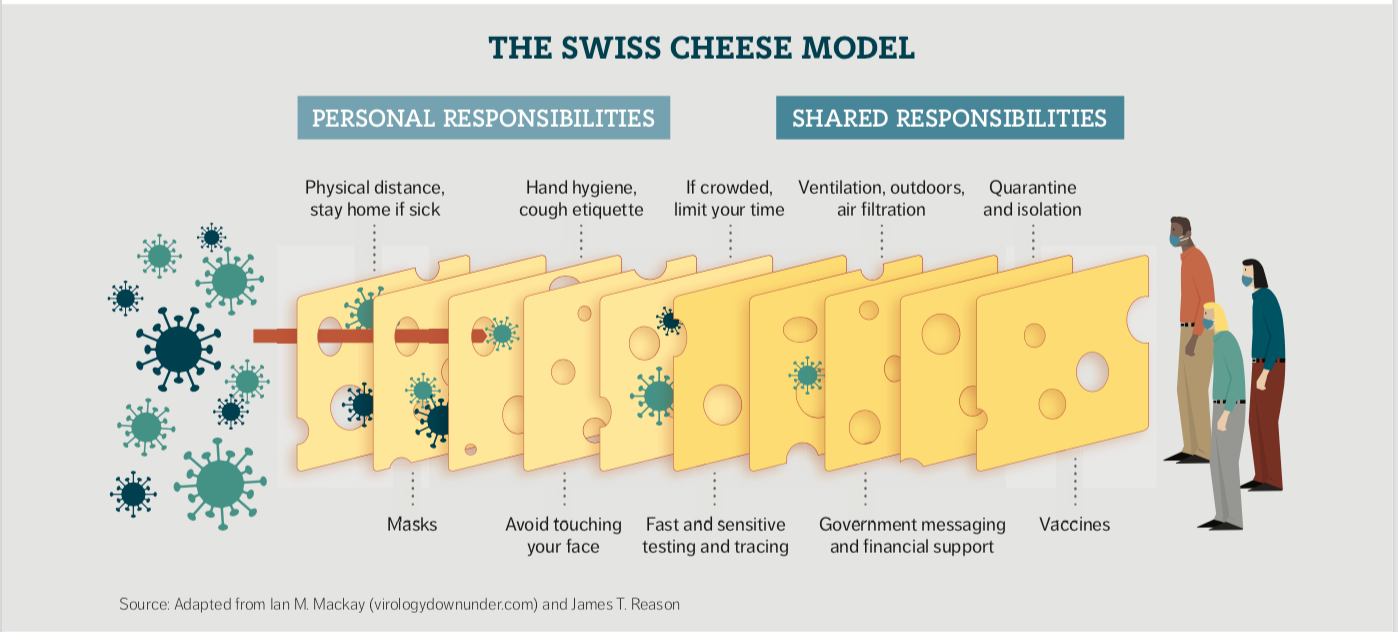
Thank you for taking care of yourself and your communities. We need all the precautions, kindness, and compassion we can get right now.
You are worthy of rest and care.
Additional Resources:
- Marz’s Positive for Covid Resources
Including guidance for exertion post-infection - TEXANALYSIS’ Reference Doc has a treasure trove of info about masking, air purification, and more.
- Threat Model’s Patreon Covid Info Page
Scroll to “If you (or someone in your home) has covid” - Bateman-Horne’s Covid-19 Page
Research group for people with ME/CFS, Long Covid, Fibromyalgia. scroll to “Care Considerations for those with ME/CFS & FM”